1 / 11
Culture & history · Jung-gu
Forty Stairs
Korean name: 40계단
Steps where war refugees longed for home
Why go
Walk the steps where Korean War refugees met lost family and traded relief goods, now a 1950s-themed street.
- Best time
- September to October, when the Forty Stairs Culture Festival is held; check the schedule in advance.
- Tip
- The stairs are free and always open; the Forty Stairs Culture Hall opens 10:00–18:00 on weekdays and 10:00–17:00 on weekends, closed Mondays and national holidays. Walk 5 minutes from Exit 11 of Jungang Station on Busan Metro Line 1.
Summarised with AI from Busan Tourism Organization's information.
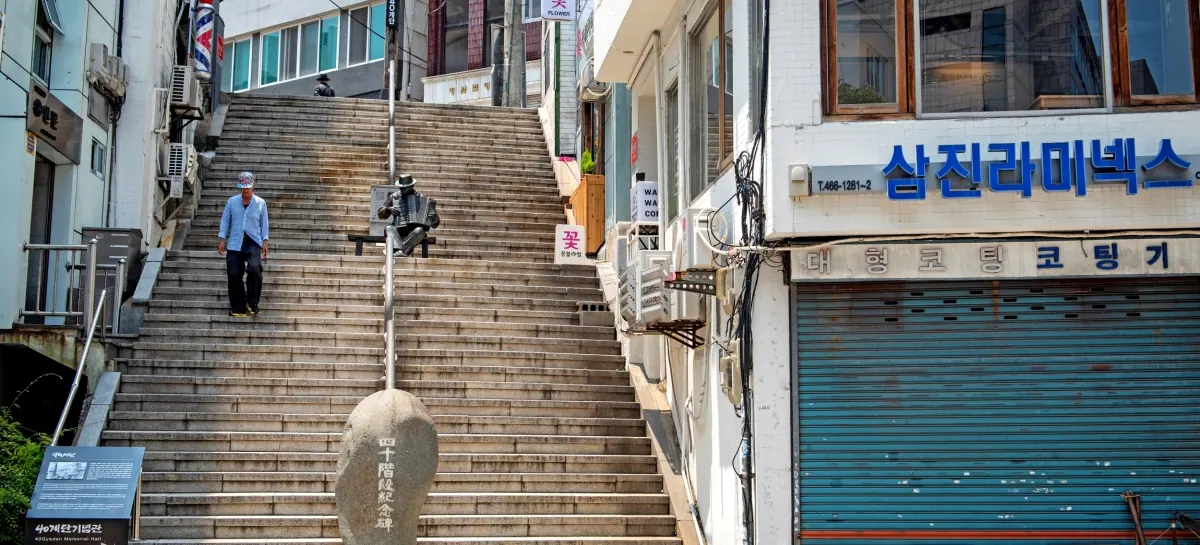
What happened to the traveler who cried on the flight of the Forty Stairs away from their sweet home? The Forty Stairs was a shelter for the refugees who yearned to go back to their hometown. Climb the 40 steps to experience what life’s sorrow must have been like for the refugees. Located nearby Jungang Station of Busan Metro Line 1, the Forty Stairs became the center of the lives of the refugees gathered from all over the country to the old Busan Station building. The Forty Stairs served as the passage that connected Busanhang Port’s dock to the shantytown on the hillside, a square where separated families met, and a market for selling relief items. There used to be a saying called “Let’s meet by the Forty Stairs in Busan,” and some waited by the stairs believing these words. The Forty Stairs is a place that contains the sorrows of a refugee’s burdensome life around Busan Station.
In April 2004, the area surrounding the Forty Stairs was established as the “Forty Stairs Street.” The street is themed after the old Busan Station and Busan Port during the 1950s and 1960s. When faced with hardships, refugees ascended and descended the Forty Stairs in tears as they listened to the accordion play to temporarily forget the hardships of life. Meanwhile, children, with hands placed over their ears, collected scattered rice puffs next to the rice puff seller and happily returned home. Fathers, who were dock workers, took naps against their carriers—an emotional sight to behold.
The Forty Stairs is an exhibition facility that shows the history and culture related to the structure. The fifth-floor exhibition hall presents the realities of the people during the Korean War. Refugees, unable to secure a single board to build a house, lived in mud huts using US army tents and made a living through manual labor and stallholding. They had no house to escape the wind and rain and no food to eat the next day, but their passion for educating the children bore fruit on the streets and inside tents.
The Forty Stairs used to be a place of sadness and tears, but now, it serves as a place of takeoff for a better future. Growing stronger over time, people continue to ascend and descend the steps over generations. The Forty Stairs will become the companion of travelers who wish to remember the history of Busan.
Plan your visit
- Address
- 49, Donggwang-gil, Jung-gu, Busan
- 부산광역시 중구 동광길49
Open in
Good to know
- Hours for facilities on site
- Every day (Forty Stairs Culture Hall: Tuesday–Sunday) Always (Forty Stairs/Culture Hall Weekdays: 10:00–18:00 / Sat/Sun: 10:00–17:00)
- Closed
- Open all year round Forty Stairs Culture Hall : Every Monday, national holidays
- Admission
- Free
- Getting there
- Walk for 5 min from Exit 11 of Jungang Station on Busan Metro Line 1 Get off Bus 17, 26, 27, 40, 41, 61, 82, 85, 87, 103, 134, 190, or 1003 at Jungang-dong
- Facilities
- Braille Guide, Accessible Facility, Elevator, Accessible bathroom
- Tip
- The Forty Stairs Culture Festival is held every September and October. Check out the schedule in advance to enjoy the festival.
Opening hours and prices can change. Please check before you go.